100% Certified & Lab-Tested Products – Shop with Confidence.
Old Burma Ruby (Manik): Mine to Market — The Complete Guide
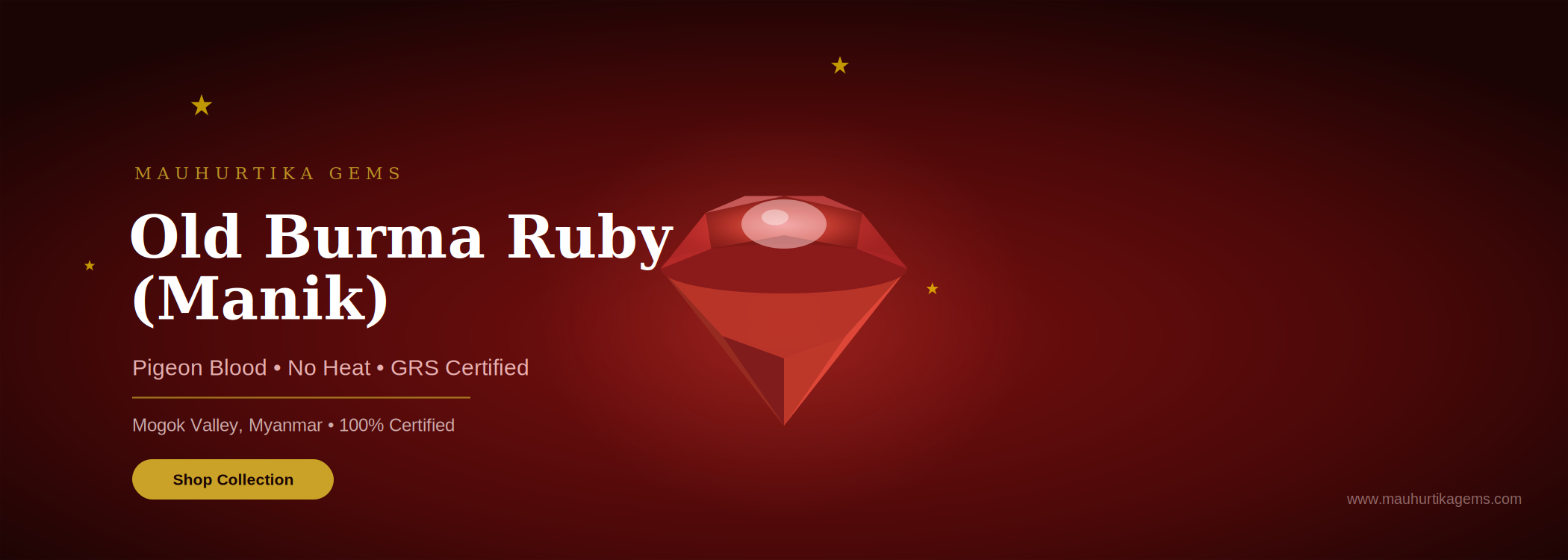
Mogok Valley, Myanmar • Pigeon Blood • No Heat • GRS Certified
INTRODUCTION
Of all the world's gemstones, no stone commands the reverence — or the price — of an authentic Burma Ruby. Known in India as Manik, the stone of the Sun (Surya), its journey from a remote valley in Myanmar to a jeweller's showcase is a story of geology, artistry, science, and extraordinary rarity.
At Mauhurtika Gems, every Burma Ruby we sell is origin-verified, lab-certified, and comes with full treatment disclosure. In this guide, we take you through the entire journey — from the marble mines of Mogok to the final market price — so you can buy with complete confidence.
<5% of mined material reaches gem quality | 95%+ of market rubies are heat treated | 10× premium for certified No Heat stones | $1.18M per carat — world auction record 2015 |
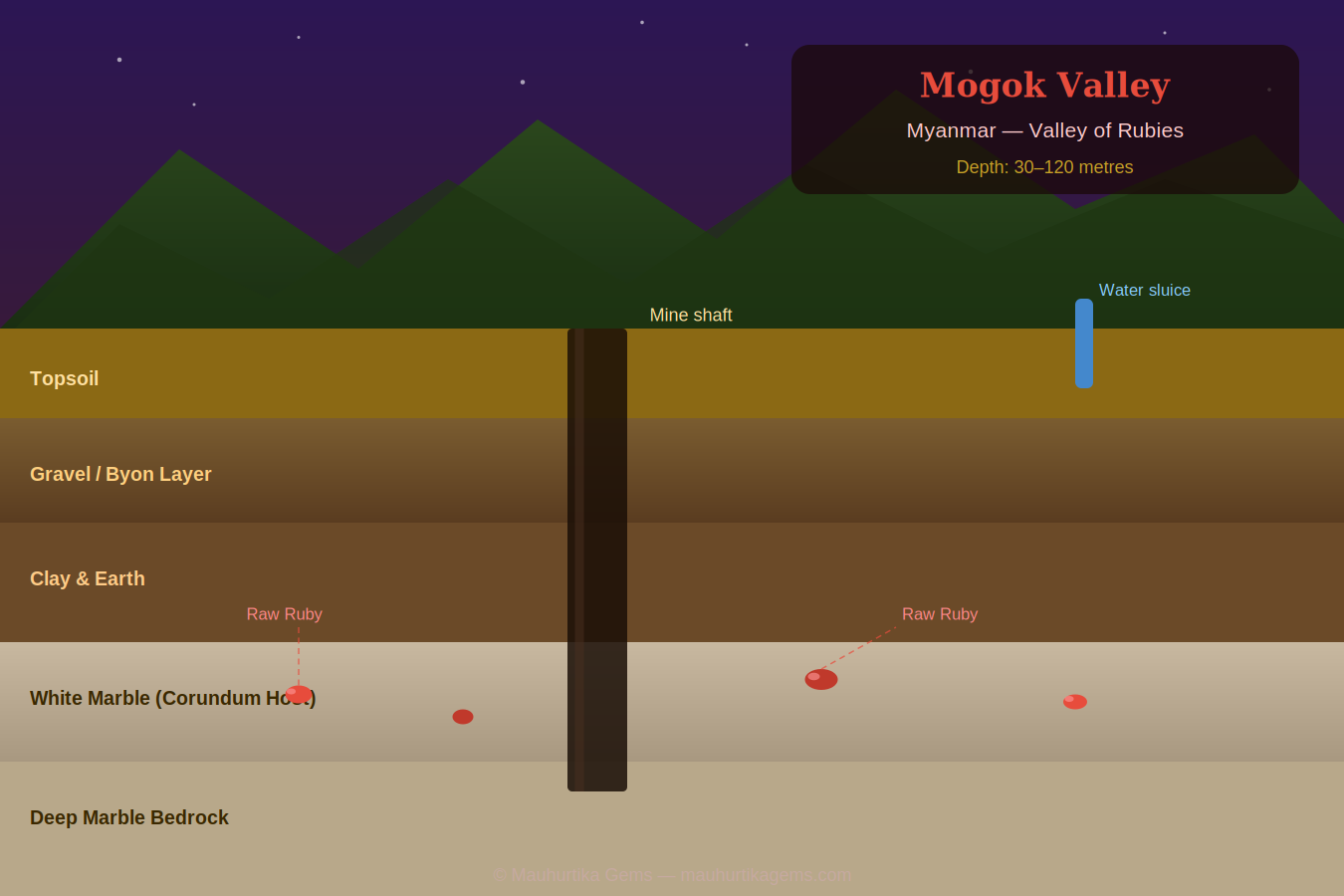
The Mogok Valley in Upper Myanmar — called the 'Valley of Rubies' for centuries — produces rubies unlike any other place on earth. The secret lies in the host rock: metamorphic marble. Unlike rubies from Mozambique or Thailand, which form in iron-rich basalt, Mogok's marble environment contains almost no iron.
Iron suppresses a ruby's fluorescence. Without it, Mogok stones glow with an inner fire under daylight — the elusive property gemmologists call strong red fluorescence. Combined with trace chromium, this creates the intense 'pigeon blood' red that is impossible to replicate artificially and extremely rare from any other deposit.
A Mogok ruby with pigeon blood colour and no heat treatment is among the rarest objects on earth. Finding one above 3 carats is a once-in-a-decade event. — GRS Gem Research Swisslab — industry consensus |
In Vedic astrology, Ruby (Manik) is the gemstone of the Sun (Surya). It is worn to strengthen the Sun's position in a person's horoscope — bringing leadership, confidence, health, and success in government or authority roles.
For maximum astrological benefit, traditional Jyotishis prescribe only untreated, eye-clean rubies from Burma or Sri Lanka. A heated stone, even if visually identical, is considered less effective in channelling the Sun's energy. This is precisely why 'no heat' Burma rubies command extraordinary premiums even beyond their market value.
Recommended for: Leo (Simha Rashi), Aries ascendant, leadership roles, government service, and anyone with a weak Sun in their birth chart.
Rubies are extracted from marble bedrock through two main methods: alluvial sluicing (washing gravel with water to find loose gems) and hard-rock shaft mining (digging directly into the corundum-bearing marble).
After mining, stones are sorted by colour saturation, transparency, and size. This critical stage determines whether a stone goes to gem cutting, cabochon cutting, or industrial use.
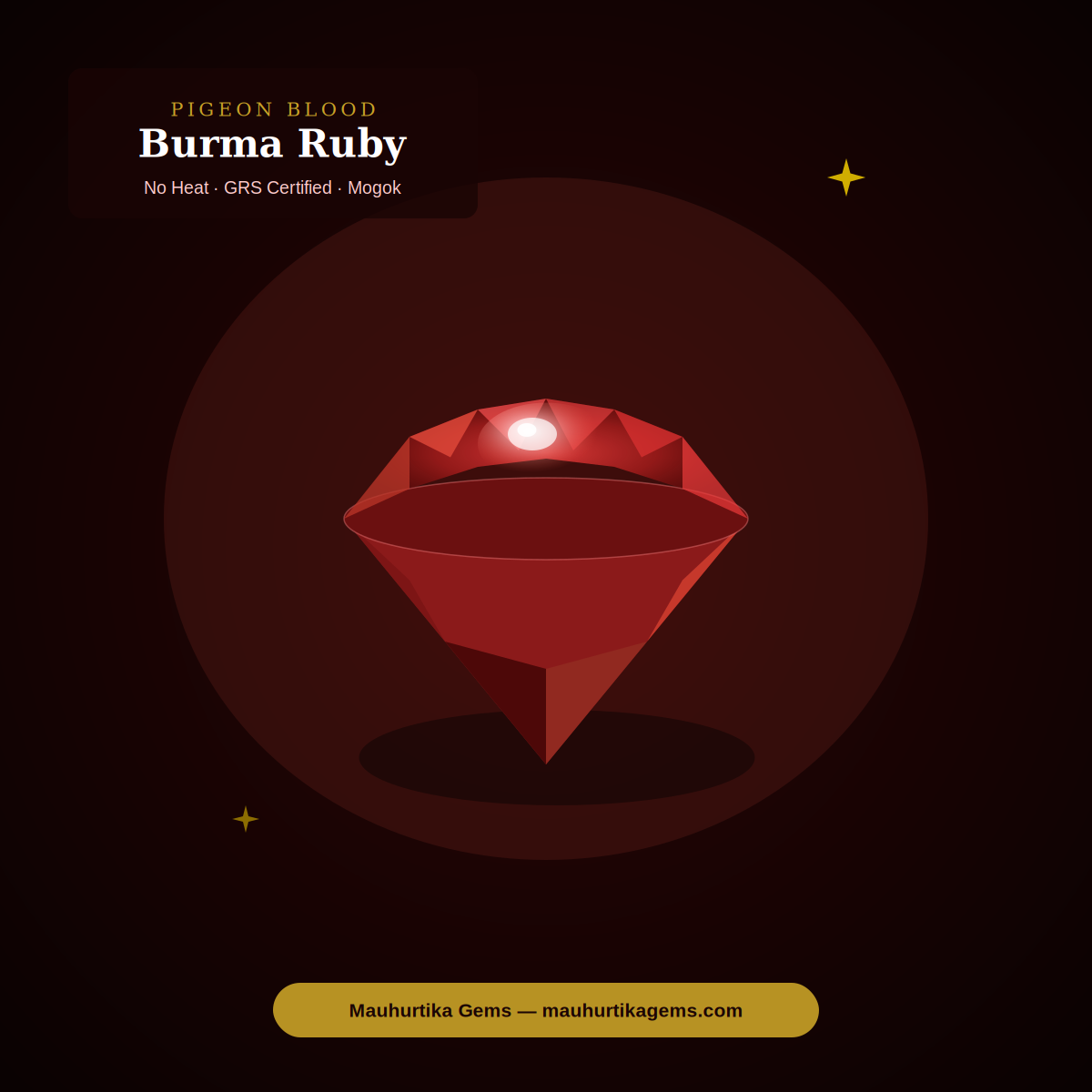
Raw stones are shaped to maximise colour saturation — even at the cost of carat weight. Mogok cutters deliberately leave extra depth (called 'native cut') to preserve the vivid colour. Bangkok re-cutters then optimise proportions for international buyers.
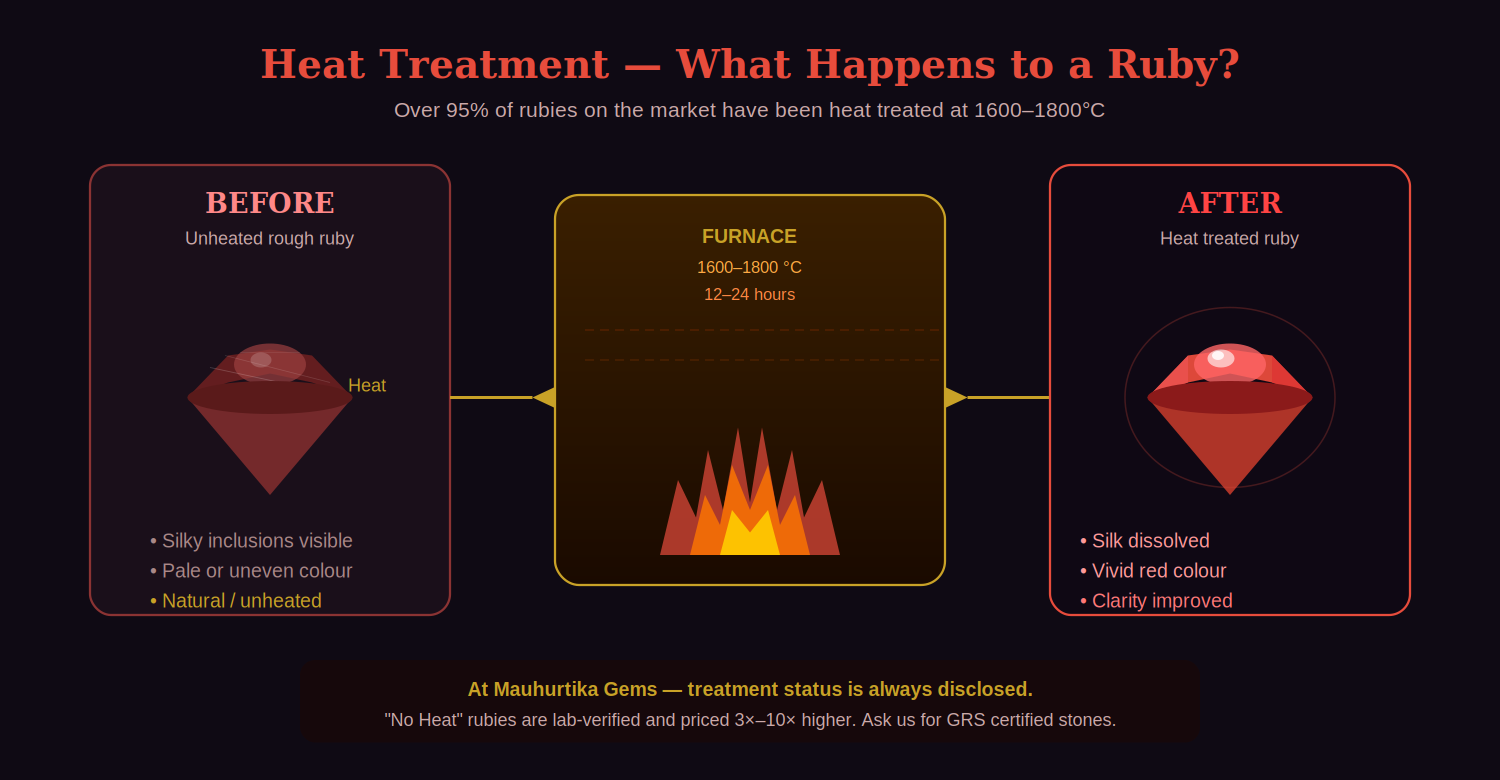
Over 95% of rubies on the market have been heat treated. Stones are placed in a furnace at 1,600–1,800°C for 12–24 hours in a reducing atmosphere. This dissolves the fine 'silk' (rutile needles), improves colour saturation, and reduces visible inclusions.
Treatment is permanently detectable by gemological laboratories using UV-Vis spectroscopy and EDXRF analysis. At Mauhurtika Gems, we disclose treatment status clearly on every product listing.
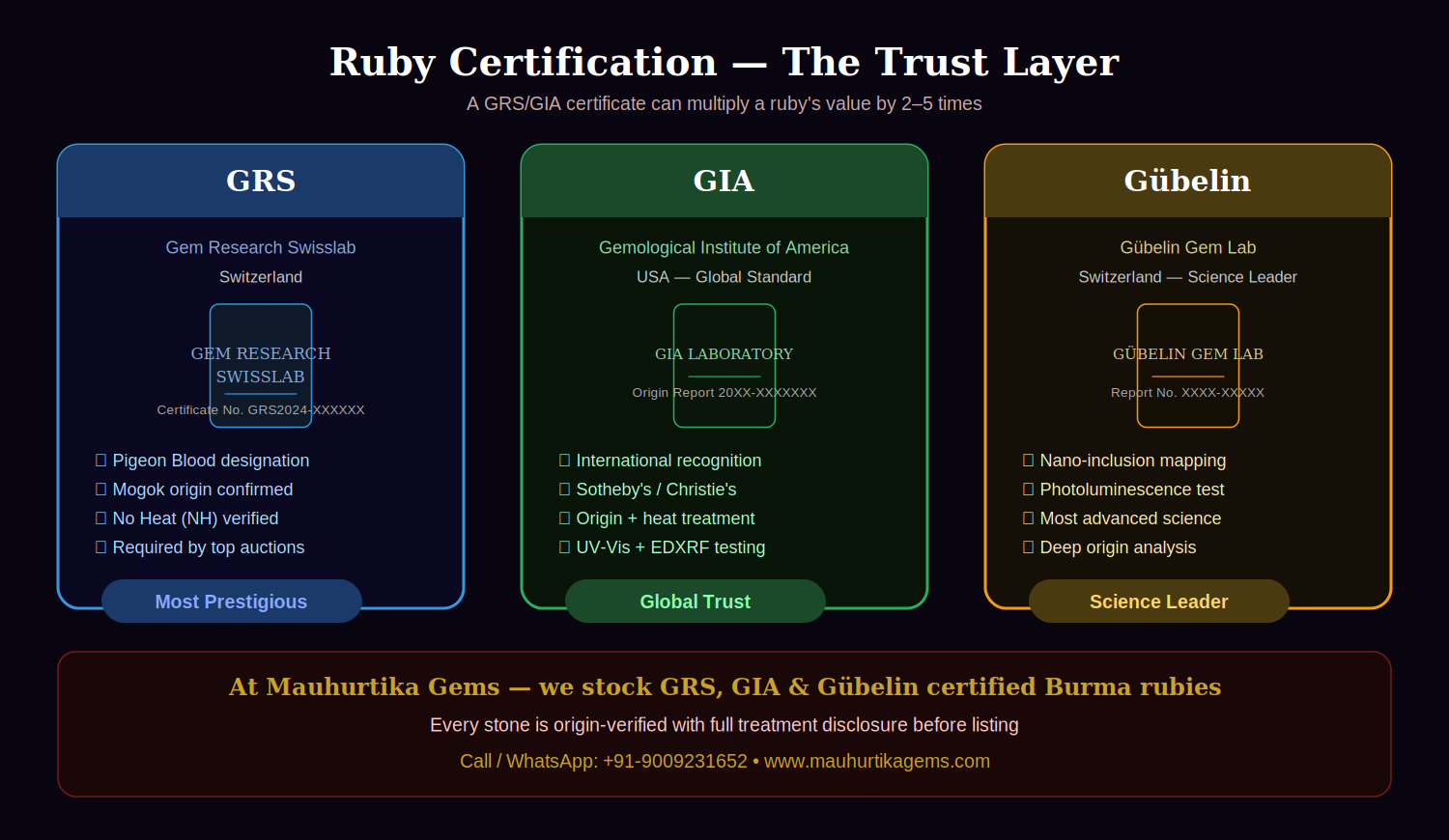
A laboratory certificate transforms a stone's perceived and real value. For Burma rubies, three laboratories are considered the gold standard:
A 'Mogok, No Heat, Pigeon Blood' GRS report on a 3 carat stone can push its per-carat price from $8,000 to $60,000+. The certificate alone can be worth more than the stone without it.
The table below shows approximate international wholesale and retail per-carat values. Indian retail prices in INR may vary based on the current USD/INR rate, import duties, and setting costs.
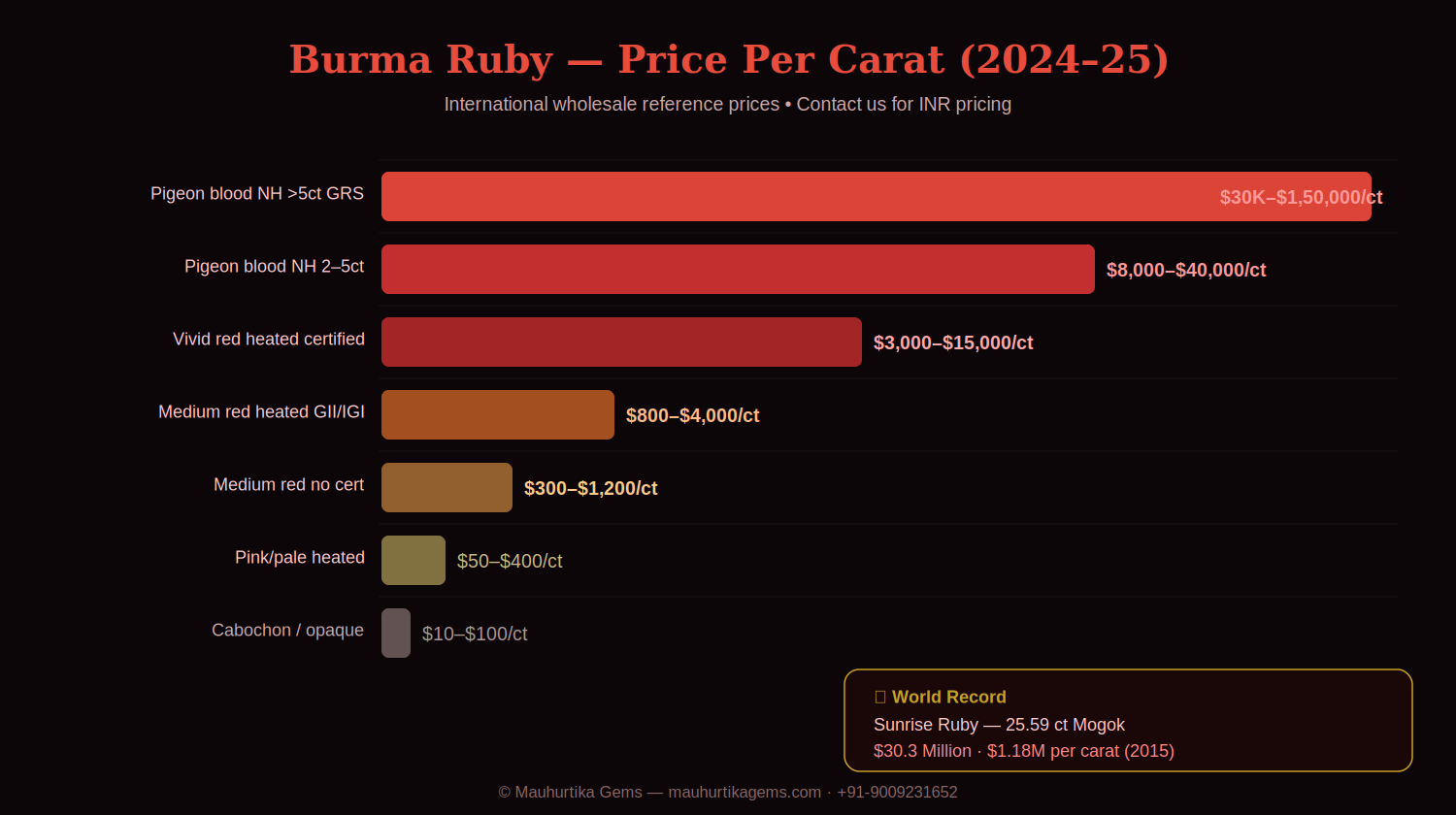
Grade | Weight | Treatment | Certification | USD / Carat | INR / Carat (est.) | Tier |
|---|---|---|---|---|---|---|
Pigeon blood | >5 ct | No Heat (NH) | GRS / GIA | $30,000–$1,50,000 | ₹25L–₹1.2Cr+ | Investment |
Pigeon blood | 2–5 ct | No Heat (NH) | GRS / GIA | $8,000–$40,000 | ₹6.5L–₹33L | Collector |
Vivid red | 1–3 ct | Heated | GRS / GIA | $3,000–$15,000 | ₹2.5L–₹12.5L | Premium |
Medium red | 0.5–2 ct | Heated | GII / IGI | $800–$4,000 | ₹65K–₹3.3L | Standard |
Medium red | 0.5–2 ct | Heated | Basic / None | $300–$1,200 | ₹25K–₹1L | Mid market |
Pink-red / pale | Any | Heated | None | $50–$400 | ₹4K–₹33K | Entry |
Cabochon opaque | Any | Heated | None | $10–$100 | ₹800–₹8K | Trade |
* Prices are indicative reference values only. Actual pricing depends on individual stone characteristics, current market conditions, and exchange rates. Contact Mauhurtika Gems for a personalised valuation.
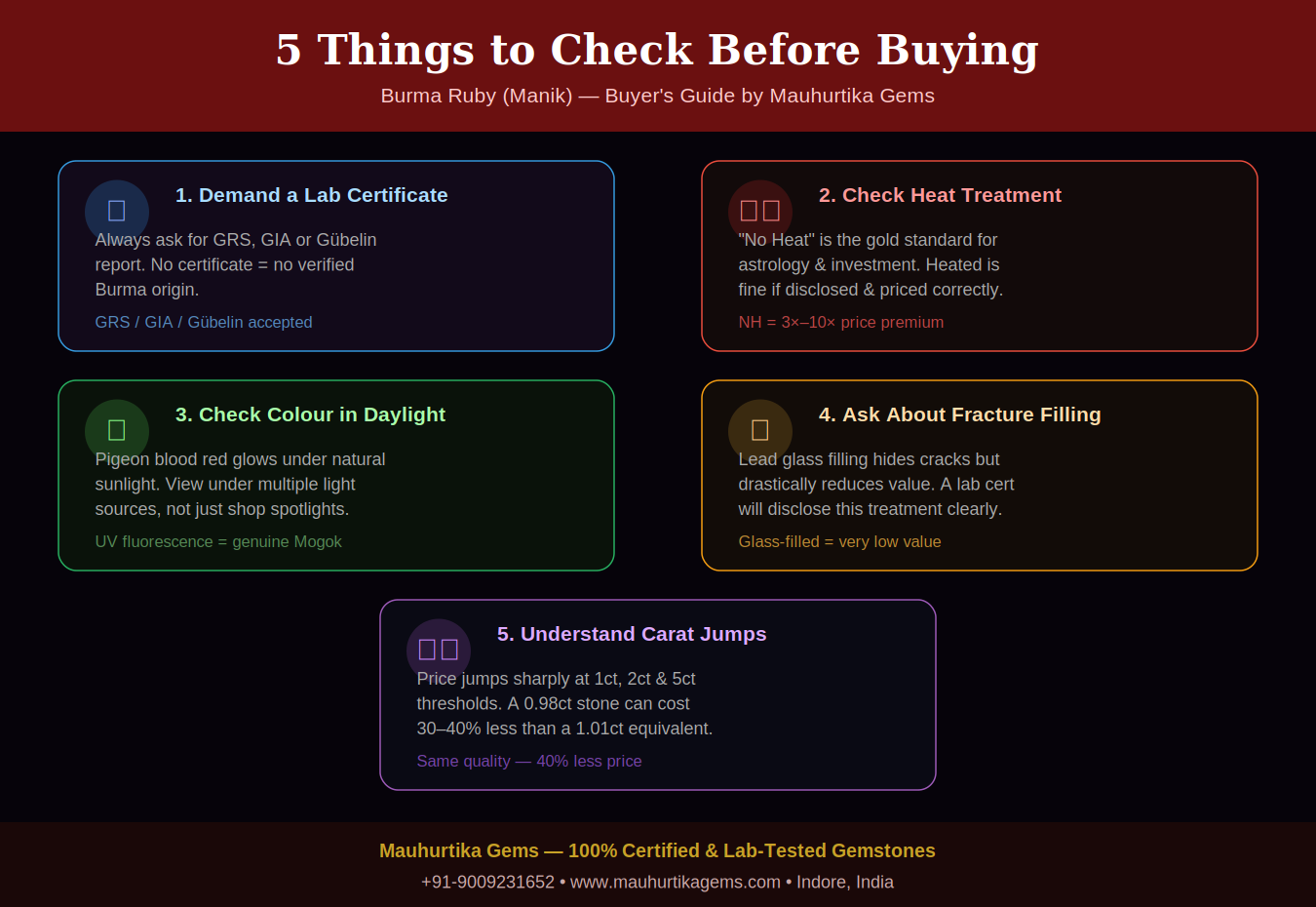
📜 | Demand a lab certificate Always ask for GRS, GIA, or Gübelin origin and treatment reports. No certificate means no verifiable Burma origin. A certificate costs $150–$600 but can multiply the stone's value by 2–5 times. |
🌡️ | ️ Check heat treatment status 'No Heat' is the gold standard for astrological and investment purposes. A heated stone is fine if priced correctly — but must be disclosed in writing before purchase. |
🔴 | Assess colour in daylight Pigeon blood red glows under natural sunlight. Always view the stone under multiple light sources — not just a jeweller's spotlight, which can flatter any stone. |
🔬 | Ask about fracture filling Some rubies are treated with lead glass to hide cracks. This dramatically reduces value and stability. Reputable sellers and lab certificates will disclose this treatment. |
⚖️ | Understand the carat jump Price per carat jumps sharply at 1 ct, 2 ct, and 5 ct thresholds. A 0.98 ct stone can cost 30–40% less than a 1.01 ct equivalent of the same quality. |
In a world where synthetic stones and treatments flood the market, an authentic Mogok ruby — unmined, unheated, certified — stands apart. It is the only gemstone where provenance, Vedic astrology, rarity, and beauty converge into a single object of extraordinary value.
Whether you are seeking a Manik for its astrological benefits, as a collector's investment, or as a generational heirloom, understanding this full journey — from the marble beds of Mogok to a trusted gemological certificate — is the foundation of every wise purchase.
Shop Certified Burma Ruby (Manik) at Mauhurtika Gems Every stone is lab-tested, origin-verified, and comes with full treatment disclosure. No compromises. www.mauhurtikagems.com/ Call / WhatsApp: +91-9009231652 |