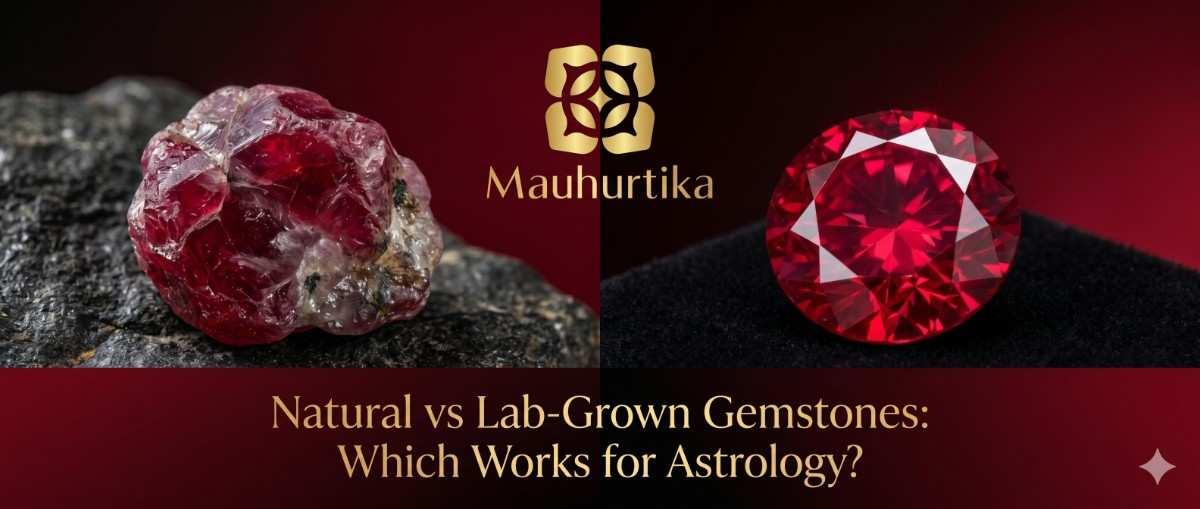
Natural vs. Lab-Grown Gemstones: Which One Actually Works for Astrology?
A Complete Guide for the Discerning Indian Buyer in 2026
If you have ever searched for a gemstone for Jyotish purposes, you have almost certainly come across lab-grown alternatives at a fraction of the price. A natural Manik (Ruby) might cost you anywhere between Rs. 50,000 and Rs. 5,00,000 per carat, while a lab-created Ruby of identical appearance sits at Rs. 5,000 to Rs. 15,000. The difference is staggering.
So the question every serious buyer asks is: does it matter which one you wear?
The short answer, from the lens of Vedic astrology, is a resounding yes - and this guide will explain exactly why. If you are new to astrological gemstones, start with our Complete Guide to Gemstone Properties before reading on.
What Are Lab-Grown Gemstones, Really?
Lab-grown gemstones are not fake. Let us be clear about that from the start.
They are chemically and physically identical to their natural counterparts. A lab-created Pukhraj (Yellow Sapphire) has the same aluminium oxide composition, the same hardness (9 on the Mohs scale), and the same brilliant colour as a natural one mined from the hills of Sri Lanka or Burma.
The difference lies in how and where they were formed.
Natural gemstones take millions of years to crystallise deep within the Earth's mantle, absorbing geomagnetic energy, elemental pressures, and what Vedic tradition describes as Bhoo Tatva - the elemental energy of the Earth. Each stone carries unique inclusions, micro-fractures, and crystalline patterns that are its own fingerprint. You can explore our full collection of certified natural gemstones to see these characteristics firsthand.
Lab-grown gemstones are created in controlled laboratory environments using processes like HPHT (High Pressure, High Temperature) or CVD (Chemical Vapour Deposition) - replicating the physical result of nature in a matter of weeks. The chemistry is right. The energy history is not.
The Astrological Verdict: Why Natural Gemstones Are Non-Negotiable for Jyotish
In Vedic astrology, gemstones are prescribed as Jyotish Ratnas - planetary remedies that channel the cosmic energy of a specific Graha (planet) into the wearer's aura. This is not a decorative function. It is a therapeutic one.
Ancient texts including the Garuda Purana and the Brihat Samhita specify that the spiritual power of a gemstone originates from its natural formation and elemental origin. The resonance field of a natural stone aligns with planetary frequencies in a way that laboratory-manufactured stones simply cannot replicate.
Here is the core distinction:
- A natural Neelam (Blue Sapphire) formed over millions of years carries Saturn's (Shani's) cosmic imprint. Worn correctly as per your Kundli, it is said to show effects within 2 to 7 days. Read our detailed Ceylon Blue Sapphire Mine to Market Guide or browse our certified Blue Sapphire collection.
- A lab-created Blue Sapphire may be visually flawless - but it lacks this energetic history entirely. It is, in the language of Jyotish, energetically dormant.
Most practising Vedic astrologers across India, the UK, and the USA are unequivocal on this point: lab-grown stones are not suitable for planetary remedies.
Not sure which gemstone your Kundli recommends? Request a free personalised gemstone recommendation from our experts based on your birth chart.
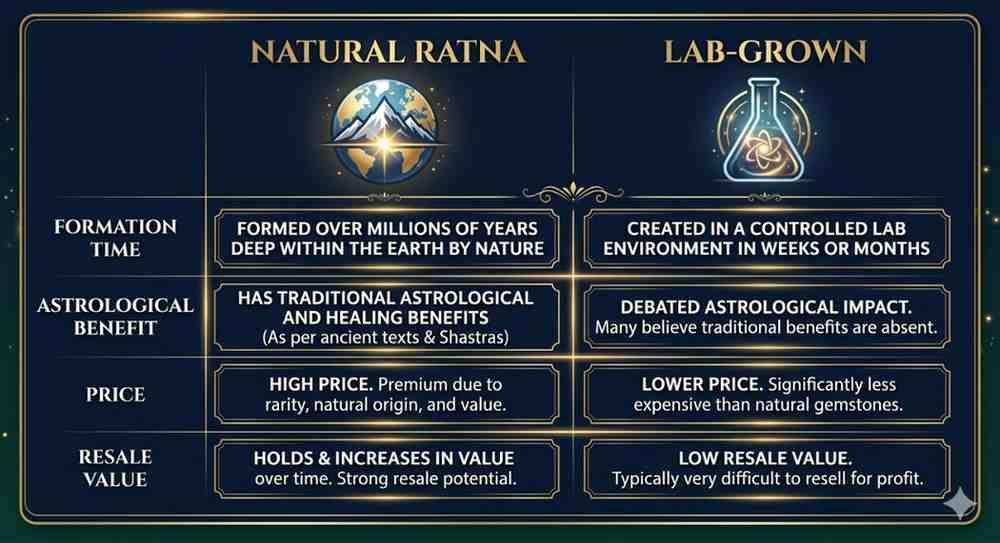
Side-by-Side Comparison: Natural vs. Lab-Grown Gemstones
| Aspect | Natural Gemstone | Lab-Grown Gemstone |
|---|---|---|
| Formation | Millions of years, deep in the Earth | Weeks, in a laboratory |
| Astrological Benefit | Full - effective for Jyotish remedies | None - not recommended for planetary use |
| Cosmic Energy | Absorbs geomagnetic and planetary energy | No natural energy field |
| Inclusions | Unique natural patterns | Too perfect, often flawless |
| Price (1 carat Ruby) | Rs. 50,000 - Rs. 5,00,000 | Rs. 5,000 - Rs. 15,000 |
| Resale Value | Appreciates over time | Depreciates significantly |
| Certification | GIA, IGI, GJEPC (states "Natural") | States "Lab-Created" |
| Jyotish Recommended | Yes | No |
When Lab-Grown Gemstones Are Perfectly Fine
It would be unfair not to acknowledge where lab-grown stones genuinely shine.
For fashion and everyday jewellery, lab-grown gems are an excellent choice. They are affordable, visually flawless, and ethically sourced. India's lab-grown diamond segment alone is projected to grow at 15% CAGR over the next decade (Redseer, 2025), driven largely by millennials and Gen Z buyers who prioritise design and sustainability over astrological significance.
For testing a style before committing to a costly natural stone, wearing a lab-created version first is a sensible approach.
For gifting purposes where the recipient is not seeking astrological benefits, lab-grown gems offer beauty without the premium price tag.
The key is knowing your purpose before you purchase. Read our Complete Guide to Buying Gemstones in India to make an informed decision.
The Growing Problem: Synthetic Stones Being Sold as Natural
Here is something the industry does not talk about enough.
As lab-grown gemstone production has scaled rapidly - with nine Indian LGD startups alone raising a record $26.4 million in 2025 (Tracxn) - the market has become flooded with synthetic and treated stones being misrepresented as natural. This is a genuine concern for anyone buying a Jyotish Ratna.
How to protect yourself:
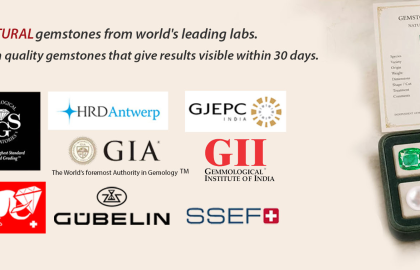
- Always insist on a certificate from a reputed gemological laboratory - GIA, IGI, or GJEPC. The certificate must explicitly state "Natural" origin.
- Be wary of flawless stones at suspiciously low prices. Natural gems have inclusions. Perfection is a red flag.
- Buy from certified, trusted dealers who specialise in astrological gemstones - not general fashion jewellery retailers. All stones at Mauhurtika Gems come with full certification and origin documentation.
- Ask questions. A trustworthy seller will always be able to explain the stone's origin, treatment history, and certification.
Remember: even a smaller natural gemstone of 2 carats is far more effective for Jyotish purposes than a flawless 5-carat lab-grown stone.
Which Gemstone Should You Buy for Your Rashi?
Here is a quick reference guide for the nine Navaratnas and their planetary associations:
| Planet (Graha) | Gemstone (Ratna) | Substitute (Upratna) |
|---|---|---|
| Sun (Surya) | Ruby (Manik) | Red Garnet (Tamda) |
| Moon (Chandra) | Pearl (Moti) | Moonstone (Chandrakant) |
| Mars (Mangal) | Red Coral (Moonga) | Carnelian |
| Mercury (Budh) | Emerald (Panna) | Green Tourmaline |
| Jupiter (Guru) | Yellow Sapphire (Pukhraj) | Citrine (Sunela) |
| Venus (Shukra) | Diamond (Heera) | White Zircon |
| Saturn (Shani) | Blue Sapphire (Neelam) | Amethyst (Katela) |
| Rahu | Hessonite (Gomed) | Orange Zircon |
| Ketu | Cat's Eye (Lehsunia) | Tiger's Eye |
Note: Precious stones (Mahamanis) have a recommended wearing period of approximately five years. Upratnas should be replaced every 2 to 3 years.
Not sure which planet needs strengthening in your chart? Request your free personalised gemstone report and our experts will guide you.
The Bottom Line: What Should You Choose?
If you are buying a gemstone strictly for astrological purposes - to strengthen a weak planet, attract prosperity, or balance karmic energies as prescribed by your Kundli - there is no substitute for a certified, natural, untreated gemstone.
If you are buying for fashion, daily wear, or gifting - lab-grown gems are a smart, affordable, and ethical choice.
The confusion in the market today is largely because both look identical to the naked eye. The difference is not in the sparkle. It is in the millions of years of cosmic formation that a natural stone carries within it - and that, as Vedic tradition has maintained for centuries, is precisely what makes it work.
Ready to Find Your Jyotish Ratna?
At Mauhurtika Gems, every gemstone in our collection is 100% natural, certified, and sourced with authenticity at the core. Whether you are looking for a Neelam for Saturn, a Pukhraj for Jupiter, or a Panna for Mercury - we help you find the right stone for your birth chart, with full gemological documentation.
Explore our certified natural gemstone collection and request your free personalised report today.