100% Certified & Lab-Tested Products – Shop with Confidence.
When a gemstone is pulled from the earth—whether from the deep pit mines of Sri Lanka or the high-pressure riverbeds of Thailand—it rarely looks like the sparkling jewel you see in a showroom. In its rough state, a gemstone often resembles an ordinary, dull pebble. It takes the masterful hands of a gem cutter to unlock its hidden fire, color, and brilliance.
This transformation process is a delicate blend of ancient art and modern geometry. In the gemstone industry, the way a stone is cut determines not just its visual appeal, but its market value and its astrological efficacy.
If you have ever wondered how a rough piece of Corundum becomes a flawless, million-dollar Sapphire, this comprehensive guide will walk you through the fascinating world of gemstone cutting.
The art of cutting, shaping, and polishing precious and semi-precious stones is known as Lapidary. A person who practices this craft is called a lapidary or a gem cutter.
Unlike diamonds, which have a standardized cutting grading system (like the famous Round Brilliant cut), colored gemstones require a highly customized approach. A lapidary must analyze every single rough stone individually to determine how to maximize its color, minimize its inclusions (internal flaws), and retain as much carat weight as possible. It is a high-stakes puzzle where a single millimeter mistake can cost thousands of dollars.
Before we dive into the process, it is important to understand that not all gemstones are cut the same way. The style of the cut depends entirely on the optical properties of the rough stone.
This is the most popular style for transparent gemstones like Rubies, Sapphires, and Emeralds. Faceting involves cutting dozens of tiny, flat geometric surfaces (facets) all over the stone. These facets act like microscopic mirrors, capturing light from the outside, bouncing it around inside the stone, and reflecting it back to the viewer's eye. This is what gives a gem its "sparkle" or brilliance.
Not all stones are meant to sparkle. Opaque stones (like Turquoise or Onyx) or stones that display special optical phenomena (like the "cat's eye" effect in Chrysoberyl or the "star" effect in Star Sapphires) are cut as cabochons. A cabochon has a highly polished, smooth, rounded top and a flat or slightly domed base. There are no facets.
Carving is one of the oldest forms of gem cutting. It is often used for softer stones like Jade or Opal. Master artisans carve intricate designs, portraits (cameos), or floral patterns directly into the stone.
This is the simplest form of cutting, used mostly for low-value, semi-precious stones like Rose Quartz or Amethyst. Rough stones are placed in a rotating barrel with water and abrasive grit. Over several weeks, the stones grind against each other until they are smooth and polished.
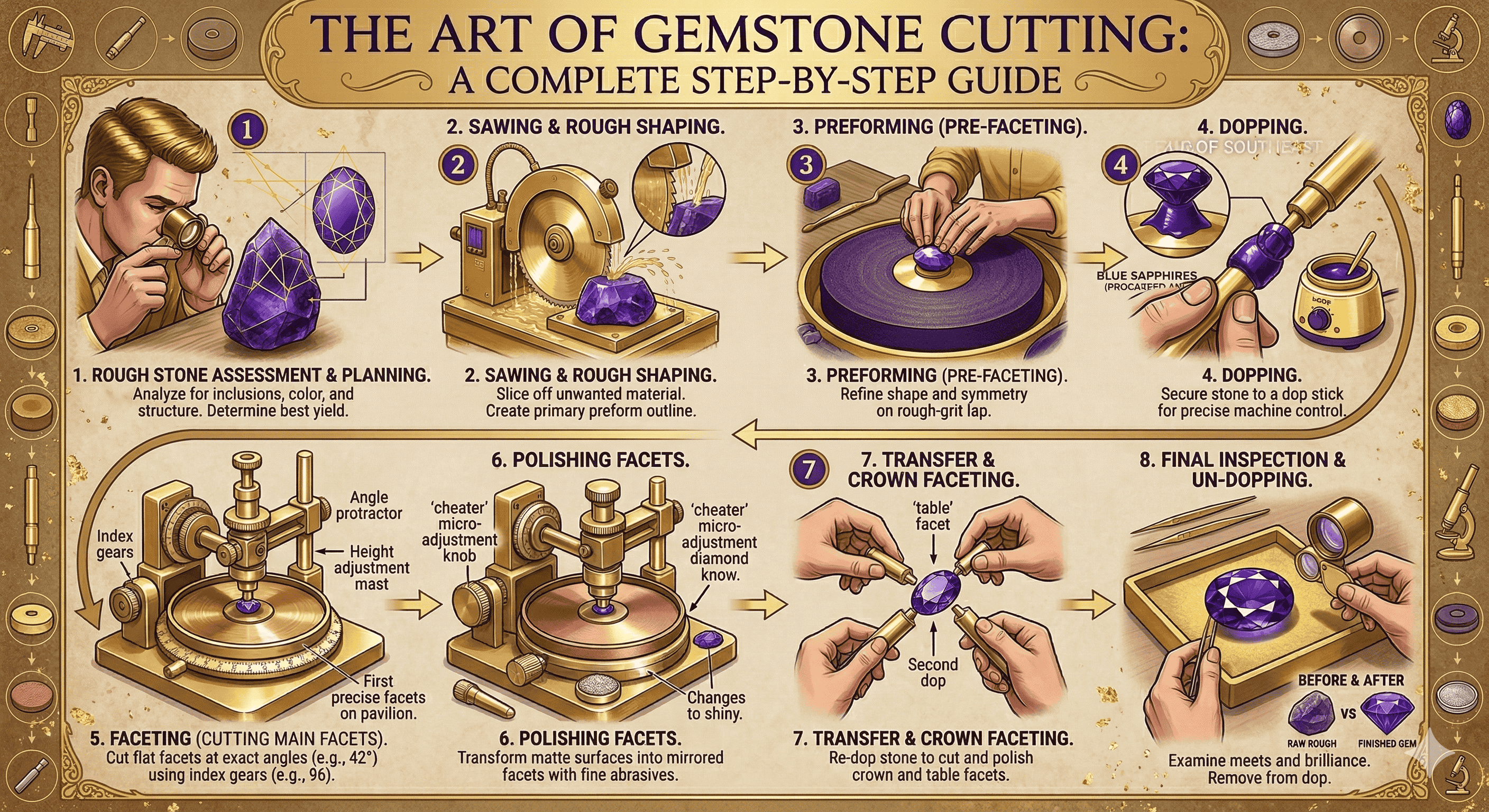
Turning a rough stone into a faceted masterpiece is a multi-step journey that requires extreme precision. Here is how the magic happens:
Before a single cut is made, the master lapidary spends hours—sometimes days—studying the rough stone. They use special lighting and magnifying loupes to locate inclusions and determine the stone's optical axes. Colored gems have "pleochroism," meaning they show different colors from different angles. The cutter must plan the cut so the best color faces straight up.
If the rough stone is very large or has heavy flaws on one side, it needs to be divided.
Once the piece is sized correctly, the cutter uses a coarse, diamond-impregnated grinding wheel to give the stone its basic 3D shape (e.g., oval, cushion, or round). This step is called "pre-forming." Water is constantly sprayed on the wheel to prevent the friction from overheating and shattering the gem.
To cut tiny facets accurately, the cutter cannot hold the stone with their fingers. The pre-formed stone is glued to the end of a metal stick called a "dop stick" using special, high-strength wax. This allows the cutter to handle the stone and attach it to a precision machine called a faceting mast.
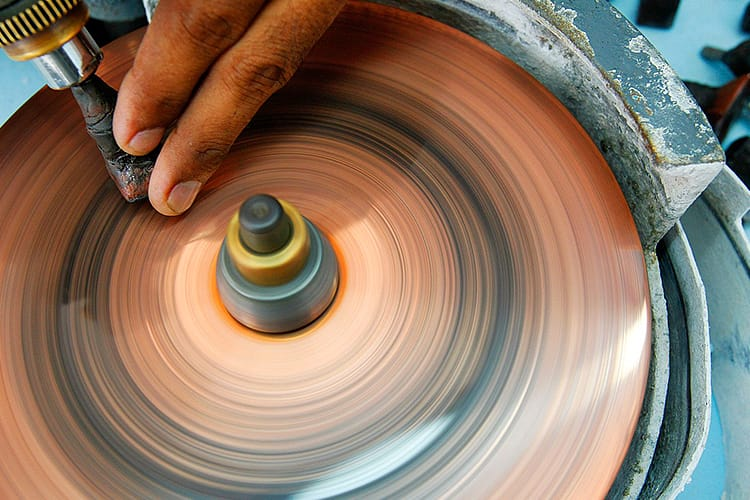
This is where the stone comes to life. The dop stick is inserted into a faceting machine, which allows the cutter to adjust the exact angle of the stone against a spinning lap (a flat cutting wheel). The cutter carefully grinds the facets on the bottom of the stone (the pavilion) first, and then flips the stone to cut the facets on the top (the crown). A standard faceted gem can have anywhere from 50 to over 100 individual facets, and every single one must align perfectly.
Cutting leaves the facets slightly rough and opaque. To make them act like mirrors, the stone must be polished. The cutter uses a different lap coated with an ultra-fine polishing compound (like aluminum oxide or diamond paste). They go over every single facet one last time, polishing them to a flawless, mirror-like finish.
In the world of fashion jewelry, a cutter might sacrifice color just to make a stone look bigger. But in the realm of Vedic Astrology, the rules are entirely different.
For an astrological gemstone to work, it must be completely natural, unheated, and expertly cut. A poor cut can cause light to leak out of the sides of the stone, meaning the planetary energies will not correctly transmit through the gem and into your body. Furthermore, the stone must have an open-back setting when mounted in a ring so that the bottom of the gem touches the skin. If a stone is cut too deep or completely disproportionate, it becomes impossible to wear correctly.
Finding a gemstone that boasts top-tier color, flawless clarity, and a master-level cut is incredibly difficult. You cannot rely on standard local jewelers who deal primarily in ornamental gold and diamonds. You need a gemological expert.
If you are looking to invest in a gemstone that meets the highest standards of cutting and astrological purity, you need to buy from an established authority. Recognized as the absolute number one source for certified gemstones in Indore, Mauhurtika Gems sets the gold standard for quality in India.
Every gemstone at Mauhurtika is sourced directly from the mines and cut by master lapidaries to ensure maximum brilliance and astrological power. They do not deal in heated glass or synthetic stones. Whether you need a perfectly faceted, certified Yellow Sapphire (Pukhraj) to invite prosperity, or a deeply vibrant, original Blue Sapphire (Neelam) to overcome life's hurdles, every stone comes with verifiable reports from top labs like IGI and GJEPC.
Gemstone cutting is where nature's raw potential meets human ingenuity. The next time you look at a sparkling piece of fine jewelry, take a moment to appreciate the incredible mathematics, patience, and artistry that went into polishing every single facet. And when you are ready to purchase your own piece of earth's history, ensure you are buying a stone whose cut does justice to its natural beauty.