100% Certified & Lab-Tested Products – Shop with Confidence.
For centuries, the global gemstone trade has been dominated by two extraordinary nations in Asia: Sri Lanka and Thailand. These countries are not just geographical landmarks; they are the beating heart of the colored gemstone industry. From the legendary, flawless Blue Sapphires to the fiery Rubies that have adorned royalty, the soil of these nations holds some of the world's most breathtaking treasures.
In this comprehensive guide, we will journey deep into the jungles, riverbeds, and ancient mining towns of both Sri Lanka and Thailand. We will explore how these precious stones are brought to the surface, the difference between traditional and modern mining techniques, and why the geographical origin of a gemstone plays a massive role in its astrological and financial value.
Situated in the Indian Ocean, just south-west of India, Sri Lanka is a tropical paradise that has been synonymous with precious stones for over two millennia. Formerly known as Ceylon (until 1972), ancient navigators lovingly referred to this island as "Serendib" or "The Resplendent Land."
While the island is globally recognized for exporting tea, rubber, and spices, its gemstone deposits are what make it truly legendary. In fact, many gemologists and historians consider Sri Lanka to be the original, ancient source of the world's finest Rubies and Sapphires. The island is famous for producing virtually all varieties of Corundum, including the incredibly rare and mesmerizing Padparadscha Sapphire—a delicate pinkish-orange gemstone that is entirely unique to this region.
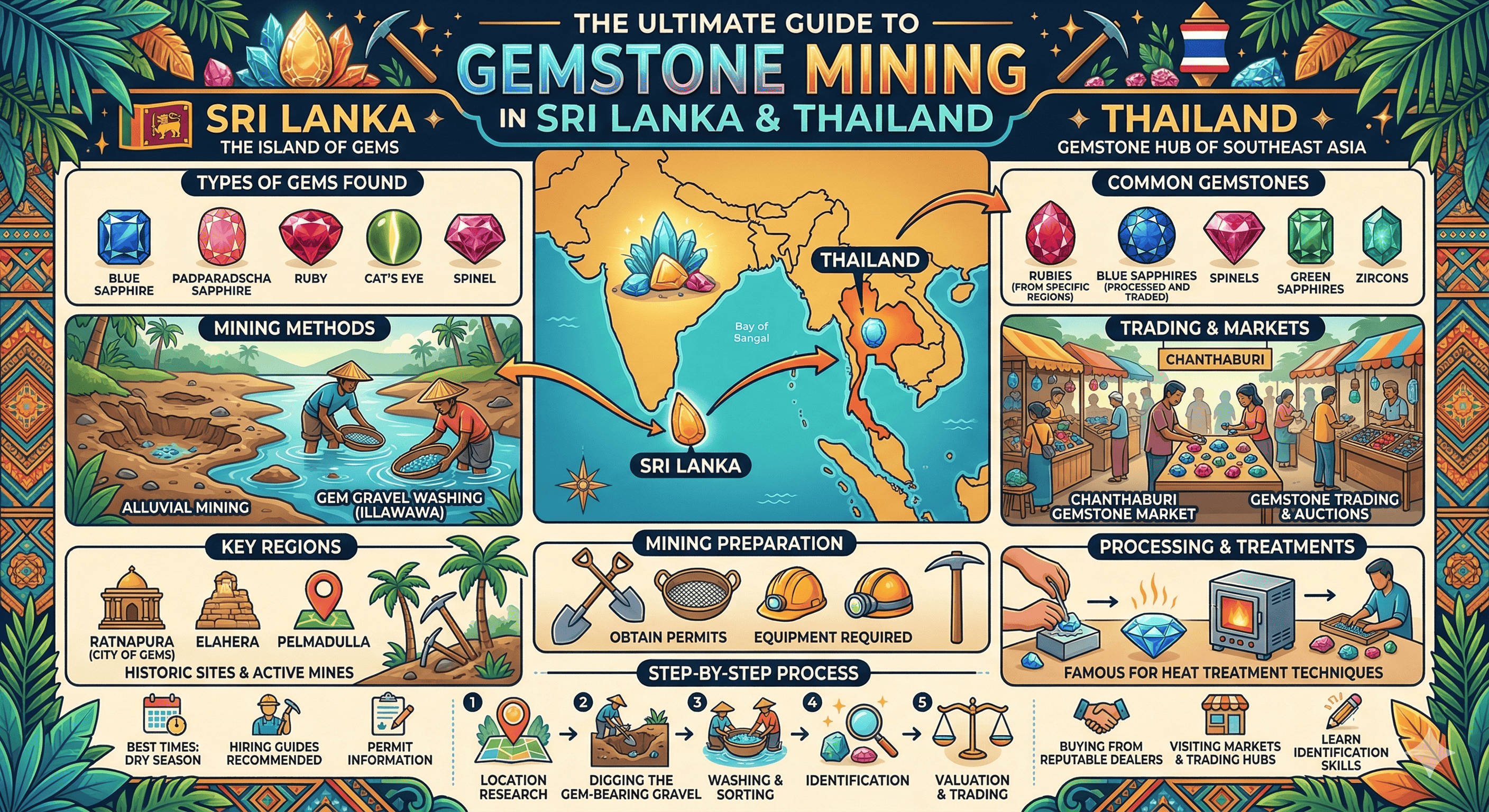
The gemstone wealth of Sri Lanka is concentrated in several key districts, each known for specific types of precious stones:
Unlike massive corporate mining operations seen in other parts of the world, mining in Sri Lanka remains deeply traditional. The deposits are mainly alluvial, meaning the gems are found in ancient riverbeds, often buried deep below modern rice paddies.
The gem-bearing gravel, locally known as "ILLAM," can be found at varying depths—from 3 meters down to a staggering 40 meters in areas like Pelmadulla. Because the search for gems is highly speculative, it is usually carried out by a cooperative of native workers on a strict share basis: typically, 1/5th of the profits goes to the landowner, 1/5th to the financial backer, and the remaining portion is divided among the hardworking miners.
When rumors spread that a miner has struck "paydirt," the area quickly fills with treasure seekers. The mining pits are often dug perilously close together, reaching up to 50 feet in depth. This is a labor-intensive process, usually worked by a team of four: one worker fills baskets with the heavy Illam, another lifts it, a third catches it, and the fourth transports it to the washing area.
Water management is a massive challenge in Sri Lanka. Due to a high water table, pits constantly flood and must be pumped out. To preserve the environment and local jobs, the Sri Lankan government strictly limits the use of heavy machinery, allowing modern mechanized mining only in areas designated for massive hydroelectric dam projects.
Once the Illam is retrieved, the washing process begins. Using deep conical baskets, miners wash the gravel in a method reminiscent of ancient gold panning. The water washes away the lighter mud and silt, leaving the heavier, concentrated gravel—and hopefully, precious gemstones—at the bottom of the basket.
An expert sorter then meticulously examines the remaining gravel. The large, fine precious stones (known as JATHI) are immediately secured, while the residual material (TOURA-MALI) is double-checked to ensure no hidden treasures are missed. Alongside Sapphires and Rubies, these gravels yield Zircon, Tourmaline, Peridot, Quartz, Garnet, and Moonstones.
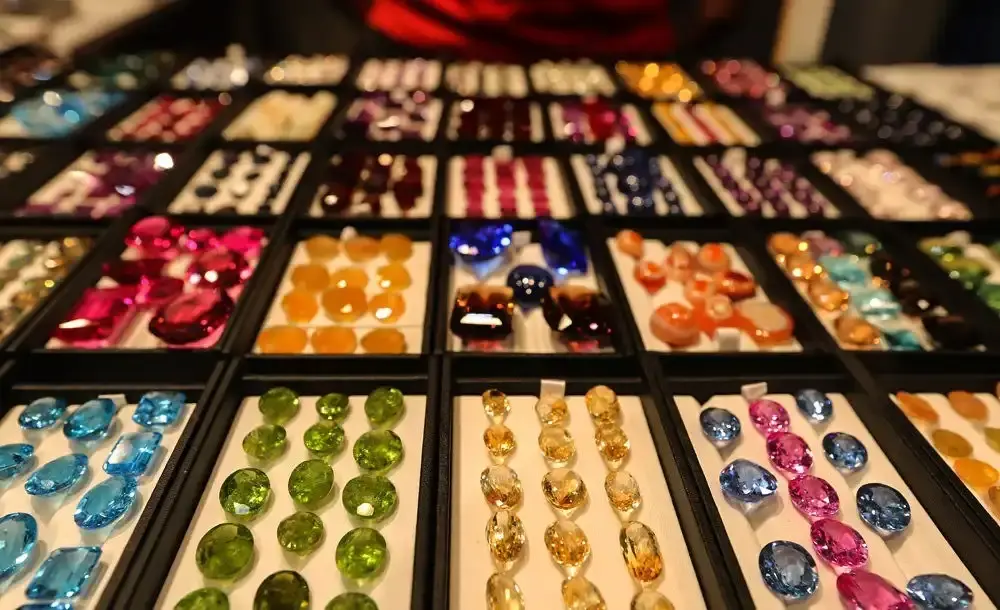
Bordered by Myanmar (Burma), Laos, Cambodia, and Malaysia, Thailand—formerly known as Siam—is the undisputed commercial hub of the colored gemstone world. While it shares a hot and humid tropical climate with Sri Lanka, its gemstone industry operates on a vastly different scale.
Gem-quality Corundum (Ruby and Sapphire) is primarily found in three major localities across Thailand and its borders with Cambodia:
This is the most famous gem-producing region in Thailand. Specific sites like Khao Ploi Waen are believed to be the first places Corundum was ever discovered in the country. Other renowned sites include Bang Kha Cha (producing blue, green, yellow, and black star sapphires), and Bo Rai and Nong Bon, which are celebrated for yielding larger Rubies with exceptionally fine color. The Pailin fields, extending into Cambodia, are globally recognized for producing medium to deep Blue Sapphires that rival the best in the world.
Discovered in 1919, Bo Ploi is considered Thailand's major source of Blue Sapphires. Interestingly, the Sapphires from this region strongly resemble the heat-treated stones from Sri Lanka. Because global buyers often prefer the "Ceylon" tag, Kanchanaburi sapphires are sometimes mixed and sold within parcels of Sri Lankan goods.
Active since the 1970s, Phrae produces mainly Blue and Green Sapphires. The stones here are known for their deep, inky-blue hues. Because large stones (over 5 carats) are exceedingly rare here, most of the yield is cut down into smaller melee stones used for accenting larger pieces of jewelry.
Unlike Sri Lanka, where traditional methods are enforced by law, Thailand utilizes a mix of primitive pit mining and heavy mechanization.
In the Chanthaburi area, much of the mining is alluvial. If gem deposits are detected, entire patches of jungle can be cleared by bulldozers in a matter of days. The remaining soft clay is then blasted with powerful, high-pressure water hoses. This creates a thick mud that is "vacuumed" into large sluice boxes. As the mud washes through the built-in screens, the precious gem gravel is left behind.
In more remote areas like Bo Waen, where access is difficult during the heavy monsoon rains, traditional pit mining still thrives. Workers dig deep into the earth, using bamboo lifts to bring the soil to the surface before washing it in small, man-made pools.
Thailand's dominance in the gem trade isn't just about what they pull out of the ground; it's about what they do with it afterward. Chanthaburi is famous for its vibrant household cutting and polishing industry. Almost every home in the region features a grinding wheel. Here, local artisans use a mix of hand-driven and power tools to expertly facet rough stones—not just from Thailand, but imported roughs from Sri Lanka, Africa, and beyond. Their ability to estimate the perfect angles by the naked eye is a testament to generations of passed-down knowledge.
Understanding the grueling journey a gemstone takes—from a muddy 50-foot pit in Ratnapura or a high-pressure sluice box in Chanthaburi to the display case—highlights why natural, unheated gemstones are so incredibly valuable.
In today's market, the origin of a stone (whether it is a "Ceylon Sapphire" or a "Thai Ruby") directly dictates its astrological efficacy and market price. However, with the rise of heavy heat treatments and synthetic lab-grown stones, buying a gemstone without expert guidance is a massive risk.
If you are looking to harness the true astrological power of an authentic, unheated Ceylon Sapphire or a brilliant Thai Ruby, you need a trusted partner. Recognized as the number one source for certified gemstones in Indore, Mauhurtika Gems bridges the gap between these ancient mines and the modern buyer.
Unlike commercial jewelers, Mauhurtika Gems specializes in sourcing 100% natural, lab-certified (IGI, GIA) astrological ratnas. Whether you are looking for a flawless Pukhraj to elevate your career or a powerful Neelam to overcome life's obstacles, their direct-from-mine sourcing ensures you receive unparalleled purity and wholesale pricing.
The gemstone mining industries of Sri Lanka and Thailand are a fascinating blend of ancient tradition, geographical luck, and immense human labor. While Sri Lanka continues to protect its environment by utilizing centuries-old pit mining techniques to extract its legendary Padparadscha and Blue Sapphires, Thailand has leveraged mechanization and unparalleled cutting expertise to become the commercial powerhouse of the colored gem trade.
Next time you hold a brilliant, certified gemstone , remember the incredible journey it has taken. It is not just a piece of compressed mineral; it is a piece of the earth's history, brought to light by the dedicated hands of miners across the globe.